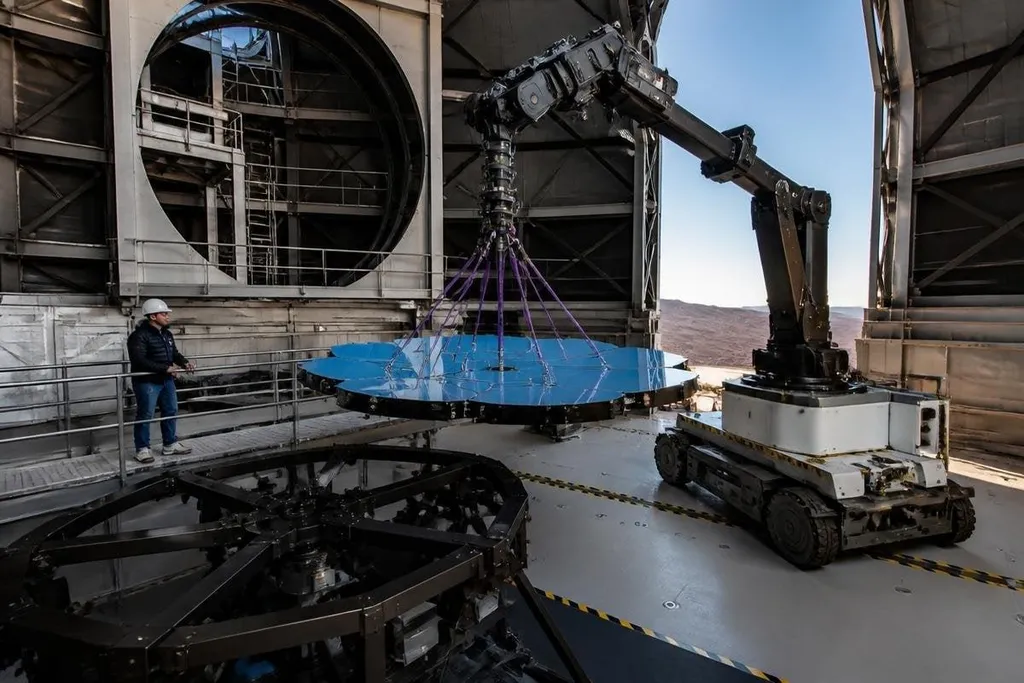
Building a large telescope means moving heavy parts into places where a small mistake can damage a mirror, a sensor, or the structure holding them.
The machines could take on repeatable jobs such as lifting mirror segments and checking alignment, while people handle work that needs judgment. For a telescope project, the useful question is not whether a robot looks clever. It is whether the machine can place parts accurately, work safely at height, and repeat the same task without tiring.
Quick read
- Mirror work: robotic arms could place and adjust segmented mirrors.
- Site work: autonomous vehicles could carry tools and parts across rough ground.
- Main limit: people still need to plan tasks, check results, and handle faults.
Where robots could help first
Large telescopes often use many mirror segments instead of one solid mirror. Each segment needs a known position, and small errors can affect the quality of the image. A robotic arm with a force sensor could lift a segment, place it on its support, and check contact before a technician makes the final adjustment.
The same arm could fit bolts, connect cables, and move protective covers. An end effector is the tool at the end of a robot arm, such as a gripper, drill, or vacuum lift. Changing that tool lets one robot handle several jobs without sending people back and forth through the structure.
Robotic systems could also inspect parts before installation. Cameras can check surfaces for damage, and laser scanners can measure the shape of a frame. That record would give the construction team a fixed reference when a part later needs repair or replacement.
Work at the telescope site
A large telescope may be built in a remote area with steep ground, dust, cold, or strong wind. Small autonomous vehicles could carry mirror containers, cables, and tools between the storage area and the building. They would need obstacle detection, a planned route, and a safe stop if a person entered their path.
That work sounds modest, but it can remove many trips for technicians carrying equipment. It also gives the project a clear log of where each part went and when it arrived. The robot would still need a person to confirm the load and inspect the route before each run.
Moving telescope parts leaves little room for a wrong route or a late stop. A dated Robot24 report can put the machine, load, and test setting beside the claim. That record matters before an inspection robot starts working around the finished frame.
Inside the telescope enclosure, a mobile inspection unit could carry a camera around the frame, check cable runs, and look for loose covers after a work shift. A robotic arm fixed to a rail could reach areas that are awkward for a person in a harness, though its movements would need strict limits near fragile equipment.
Alignment is where the details matter
Telescope mirrors must point in the right direction and keep their shape as the structure moves. Actuators, which are small powered devices that adjust position, can move mirror segments by tiny amounts. After reading the sensors, the robot could make one adjustment and measure the result before repeating the cycle.
That process needs a known reference. The team would have to calibrate the robot, the sensors, and the telescope structure together. Temperature changes, vibration, cable tension, and dust could all affect the readings, so a robot that places a part well may still produce a poor result if the measurement system is wrong.
I’d support robots for the heavy and repeatable work, but I wouldn’t hand them final acceptance of a mirror or structure. A person should review the measurements before the project moves on.
The limits teams should plan for
Robots work best when the task, tool, and surroundings stay within known limits. Telescope construction rarely stays that tidy. A part may arrive in the wrong position, a cable may snag, or a sensor may give a reading that does not match the physical setup.
The robot also needs a recovery plan. That can mean returning to a safe position, holding a load in place, or asking a technician for help. Remote control can cover some faults, but a long network delay or a blocked camera can turn a small problem into a stopped work area.
A practical plan should check these points before buying a robot:
- Name the repeatable task: choose lifting, inspection, fastening, or transport before choosing a machine.
- Set the load limit: include the tool, cable, and part weight in the calculation.
- Map the work area: mark slopes, narrow routes, fragile surfaces, and human access points.
- Define the handoff: state where a technician takes control and what evidence they review.
- Test the failure cases: include blocked sensors, lost communication, and a part placed outside its expected position.
The first useful robots on telescope projects will probably be machines with clear jobs and simple recovery steps. They can reduce lifting and inspection work, but people will still decide whether the telescope is ready to observe the sky.